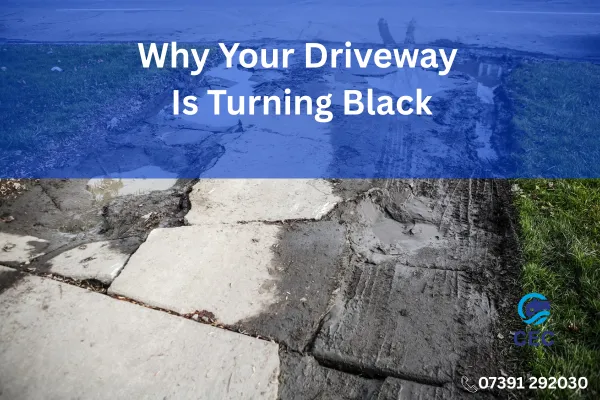
Why Your Driveway Is Turning Black
You step outside one morning and notice it properly.
Your driveway, which used to look bright and clean, is slowly turning dark. In some places it’s almost black. In others it looks greenish or patchy.
It has not suddenly deteriorated overnight. It has crept up gradually.
The good news? This is extremely common. The better news? It is completely fixable.
Let’s look at what is actually happening and how to deal with it properly.
Why Driveways Turn Black in the UK
The British climate is perfect for surface growth.
We have:
Damp weather
Regular rainfall
Mild temperatures
Shaded areas around homes
That combination encourages organic growth on hard surfaces.
The black colour you are seeing is usually a mix of:
Algae
Moss
Lichen
Traffic film
General grime
Block paving, concrete and tarmac are all slightly porous. That means moisture sits on the surface, especially in shaded areas. Once moisture settles, spores grow.
Over time, the surface darkens.
It Is Not Just Dirt
Many homeowners assume the driveway is simply “dirty”.
In reality, it is often living growth.
Algae forms a thin biofilm. Moss anchors itself into joints. Lichen bonds stubbornly to the surface.
That is why rain alone does not wash it away. It needs proper treatment.
Why It Gets Worse Over Time
Left untreated, driveway staining and growth will:
Spread further across the surface
Become darker and more visible
Make the driveway slippery
Trap moisture
Encourage weeds in joints
The longer it is left, the deeper it embeds into the surface.
What starts as light discolouration can become thick, stubborn staining.
The Safety Risk Most People Ignore
It is not just about appearance.
Algae and moss become extremely slippery when wet. After rain, shaded driveways can feel almost like ice.
This is especially important if:
You have children
Elderly relatives visit
The driveway slopes
You use the area regularly
Professional driveway cleaning does more than improve appearance. It restores grip and improves safety.
Can You Clean It Yourself?
Some homeowners try to tackle black staining with a domestic pressure washer.
It can remove surface dirt, but there are risks:
Uneven striping
Damaging block paving edges
Blasting out jointing sand
Spreading spores rather than killing them
Without proper after-treatment, the black staining often returns quite quickly.
That is because the root cause has not been addressed.
The Proper Way to Fix a Black Driveway
Professional driveway cleaning typically involves:
Deep pressure washing using commercial equipment
Removing organic growth safely
Re-sanding block paving if required
Applying a biocide treatment
It is that final step many people overlook.
What Is Biocide Treatment and Why Does It Matter?
Biocide treatment is an additional protective step applied after cleaning.
It works by:
Killing remaining algae spores
Preventing regrowth
Slowing down future staining
Extending the clean appearance
Without biocide, microscopic growth can remain in the surface. It may not be visible straight away, but it allows the black staining to return faster.
Biocide treatment is especially effective on:
Block paving
Concrete
Patios
Shaded driveways
It is not harsh or damaging when professionally applied. Instead, it quietly continues working after the cleaning is complete.
This is why it is often recommended as part of a thorough driveway cleaning service.
How Long Do Results Last?
The longevity depends on:
Sunlight exposure
Tree cover
Nearby traffic
Drainage
However, when professional cleaning is combined with biocide treatment, results typically last significantly longer than cleaning alone.
Annual or biennial cleaning keeps maintenance straightforward and cost-effective.
It Is Not Just About Looks
Yes, a clean driveway dramatically improves kerb appeal.
But it also:
Protects the surface
Reduces weed growth
Improves safety
Maintains property standards
If you are thinking of selling your home, the driveway is one of the first things buyers see.
A dark, stained entrance can make the whole property look tired.
A freshly cleaned driveway transforms the front of the house instantly.
The Simple Solution
If your driveway is turning black, it is not unusual and it is not permanent.
Professional driveway cleaning in Colchester removes deep staining safely and restores the original colour of the surface. Adding a biocide treatment helps keep it looking cleaner for longer.
Ready to Restore Your Driveway?
If your driveway is dark, slippery or overdue a proper clean, now is a sensible time to deal with it.
Colchester Exterior Cleaning provides professional driveway cleaning in Colchester and surrounding areas, including optional biocide treatment to prevent regrowth and protect your surface.
Get in touch today for a free quote and bring your driveway back to life.
A clean driveway makes a real difference. And once it is done properly, you will notice it every time you pull up outside your home.

