Roof Moss in Colchester: When Does It Need Removing?
You look up at your roof one day and notice a few green clumps between the tiles.
Six months later there seem to be considerably more.
Then pieces start appearing on the driveway after rain.
At this point, it’s natural to wonder whether the moss is damaging your roof.
Search online and you’ll find everything from people saying roof moss is completely harmless to companies suggesting your roof is heading for disaster unless it’s cleaned immediately.
The reality is much less dramatic.
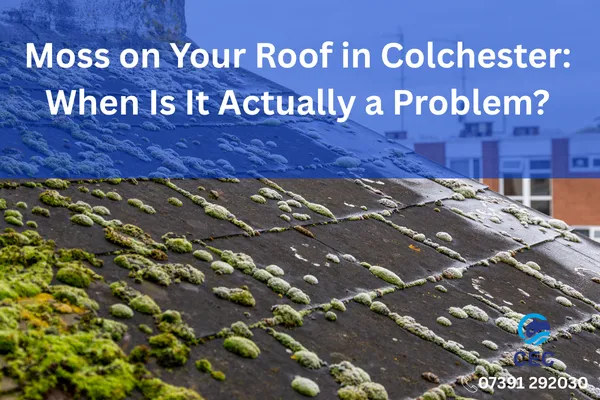
A small amount of moss on a roof isn't automatically a problem. Heavy growth can become an issue, particularly when it starts interfering with drainage, dropping into gutters or keeping parts of the roof damp for longer.
So how do you know when you should leave it alone and when it’s worth considering professional roof moss removal?
Let’s look at it properly.
Why Does Moss Grow on Roofs in Colchester?
Moss likes moisture.
It also prefers areas where surfaces stay damp for longer.
That's why two sides of the same roof can look completely different.
One side may be relatively clear while another is heavily covered.
Roof manufacturer Marley explains that moss and lichen are more likely to develop in shady, damp conditions and around properties with nearby trees. North-facing roof slopes can also be more susceptible because they receive less direct sunlight and remain damp for longer.
The pitch of the roof can make a difference too.
A steeper roof generally sheds water faster.
A shallower roof may remain wet for longer after rainfall.
Now look at the average residential street around Colchester.
You’ve got mature trees in established neighbourhoods, shaded gardens, rooflines facing in different directions and the usual British weather.
It’s hardly surprising that moss turns up.
Homes around Lexden, West Bergholt and other established parts of the Colchester area can be surrounded by mature vegetation. Newer properties in Stanway or Highwoods can develop moss too if part of the roof stays shaded or damp.
Moss isn't a sign that somebody has failed to clean their house.
It’s a natural outdoor growth that has found conditions it likes.
Is a Small Amount of Roof Moss Harmful?
Usually, a light covering isn't an emergency.
Marley advises that low to moderate levels of moss and lichen are often part of the normal ageing of a pitched roof and aren't generally harmful to tiles or slates under normal circumstances.
That matters because homeowners are sometimes encouraged to clean a roof simply because a few green patches can be seen from the road.
A roof doesn't have to look brand new throughout its entire life.
If there’s light moss growth, the roof is otherwise in good condition, water is draining correctly and the gutters are clear, immediate removal may not be necessary.
Historic England takes a similarly practical approach to roof inspection. Its maintenance guidance recommends looking for excessive moss alongside more obvious problems such as slipped, broken or missing tiles.
The word excessive matters.
We're interested in how much moss is present and what it's doing.
When Does Roof Moss Become a Problem?
The situation changes when moss becomes thick and widespread.
Dense growth can begin to interfere with how water moves down the roof.
Historic England warns that significant moss growth can potentially block gutters and pipes or interfere with water running off the roof.
Marley also says heavy moss and lichen can inhibit water flow across tiles, leaving the roof covering wetter for longer.
At this point, the moss has moved beyond being purely an appearance issue.
You may also notice chunks breaking away during rain or windy weather.
Those pieces have to go somewhere.
Quite often, they end up in the gutter.
Roof Moss and Blocked Gutters Often Go Together
If you've got a mossy roof, look at the gutters as well.
Loose moss gradually moves down the roof.
Rain carries pieces towards the gutter line.
Leaves, twigs and general debris join it.
Eventually, you can end up with a surprisingly substantial blockage.
The Society for the Protection of Ancient Buildings notes that gutters and downpipes commonly become blocked when leaves, moss and debris are allowed to accumulate.
Once the gutter is full, rainwater can't move away as intended.
You may see water spilling over the edge during heavy rainfall.
There can also be staining down the exterior wall.
Sometimes homeowners contact us because they think they only have a gutter problem.
When we look up, there’s a substantial amount of moss sitting immediately above it.
Cleaning the gutter solves the immediate blockage.
If large amounts of roof moss continue falling into it, the problem may return.
How Can You Tell if Your Roof Has Too Much Moss?
You don't need to climb onto the roof to get a useful idea.
In fact, climbing up there yourself is something we'd strongly avoid.
Stand somewhere safe where you can see the roof clearly.
Look at how much of the tile surface is covered.
A few scattered patches are very different from thick clumps covering large sections.
Also look towards the gutter line.
Can you see moss collecting there?
Are pieces sitting on lower roofs or extensions?
Do chunks regularly appear on the patio or driveway after rain?
If you can safely view the roof from an upstairs window, you may get a clearer picture.
Your phone camera can also help.
Zoom in from ground level and take photographs.
You may spot more detail by looking at the photograph afterwards than you can while standing outside squinting at the roof.
Look at the Ground Too
Your roof often leaves clues underneath it.
Have a look around the property after wet or windy weather.
Are pieces of moss landing on the driveway?
Is it appearing on the patio?
Can you see chunks on a conservatory roof?
Is moss collecting beside downpipes or near drain covers?
If substantial quantities are regularly falling from the roof, there's clearly a fair amount growing up there.
This can be particularly obvious during autumn and winter.
Leaves and roof moss then combine in the guttering, creating exactly the sort of mixture that can stop water flowing properly.
Does Moss Damage Roof Tiles?
This is where the answer needs some care.
A small amount of moss isn't automatically damaging your roof tiles.
Heavy growth can create conditions where parts of the roof stay wetter for longer.
The Society for the Protection of Ancient Buildings warns that excessive moss can retain moisture and may contribute to deterioration of certain roof coverings.
It also notes that on clay plain-tiled roofs, frost damage can be made worse where moss retains moisture.
The condition and material of your roof therefore matter.
An older, weathered roof deserves a different approach from relatively new concrete tiles in good condition.
That’s another reason roof cleaning shouldn't begin with somebody deciding that maximum pressure will produce maximum results.
The roof should be assessed first.
Can Moss Lift Roof Tiles?
You’ll sometimes see claims that every piece of moss is forcing tiles apart.
That’s an oversimplification.
Roof problems can have many causes.
Tiles may slip, crack or deteriorate for reasons completely unrelated to moss.
If you can see an obviously displaced or broken tile, treat that as a roofing issue.
Cleaning won't repair it.
Heavy biological growth around existing defects may make inspection more difficult, so clearing excessive moss can sometimes make the roof condition easier to assess.
If we spot something during exterior cleaning that looks like it needs a roofer's attention, that should be dealt with as a repair issue.
Roof cleaning and roof repair are different jobs.
Why Does Moss Grow More Heavily on One Side?
This is extremely common.
One side of the roof might look almost clean.
Turn the corner and the other slope is green.
Sunlight is usually part of the explanation.
A roof slope receiving less direct sunlight can take longer to dry after rain.
Nearby trees can increase shade further.
Buildings close to the property can have a similar effect.
Marley specifically identifies north-facing elevations, shade and nearby trees as conditions where moss and lichen are more likely to flourish.
So if the back of your house has considerably more moss than the front, there isn't necessarily anything wrong with the roof.
The conditions may simply suit moss better.
Do Trees Make Roof Moss Worse?
They can contribute.
Trees create shade and reduce the amount of direct sunlight reaching parts of the roof.
They also drop leaves and other organic material.
That debris can collect in roof valleys and gutters.
There’s no suggestion that everyone with a mossy roof should start removing healthy trees.
It simply explains why some properties need more regular roof and gutter checks.
If branches are heavily overhanging the roof, appropriate pruning may improve light and airflow.
Any tree work should be done safely and, where relevant, with proper consideration for protected trees or conservation-area controls.
Does Moss Mean My Roof Is Leaking?
No.
Seeing moss from the garden doesn't mean water is coming through your roof.
A roof can support moss without leaking.
If you have damp patches inside, staining on ceilings or evidence of moisture in the loft, that's different.
Historic England recommends checking for signs of dampness on ceilings and within loft spaces when assessing the condition of a roof.
Leaks need proper investigation.
Removing moss alone isn't a repair for a leaking roof.
If the roof has damaged tiles, failed flashing or another defect, you need the cause identified.
What Happens if You Ignore Heavy Roof Moss?
It depends on how heavy the growth is and the condition of the roof.
The most obvious issue is continued shedding.
Moss breaks away.
It falls down the roof.
It lands in the gutters.
The guttering then requires more frequent clearing.
Thick growth can also make inspection more difficult because it obscures parts of the roof covering.
Heavy moss may hold moisture and slow water drainage across the surface.
At some point, leaving it alone stops being the easiest option.
That doesn't mean you need to rush outside every time you see a green patch.
It means substantial growth is worth assessing.
Can I Remove Roof Moss Myself?
This is where we'd strongly urge caution.
The moss itself is only half the problem.
Getting to it is the bigger issue.
Working on a pitched roof carries obvious risks.
Roof tiles may also be more fragile than they appear.
Walking across them can crack or dislodge tiles.
Marley explicitly advises homeowners against accessing roofs themselves to remove moss or lichen because of the risks of injury and accidental roof damage.
Cleaning from a ladder isn't necessarily safe either.
You’re working at height while using tools and dealing with loose, wet organic material.
Saving the cost of professional cleaning isn't much consolation if the result is a fall or a damaged roof.
Should You Pressure Wash Moss Off a Roof?
This needs particular care.
A pressure washer can remove moss very quickly.
That doesn't mean it's automatically an appropriate way to clean roof tiles.
Marley advises that high-pressure washing can damage tiles, particularly older or more delicate ones. It can also drive unwanted water and debris into areas where it shouldn't go.
Spraying upwards from ground level creates another potential problem because water can be forced beneath overlapping tiles.
Roof cleaning methods should be chosen according to the roof covering, its condition and the level of growth.
Aggressive cleaning isn't a sign of a better clean.
The aim is to remove unwanted growth without damaging the roof underneath.
What About Scraping Roof Moss?
Mechanical removal may be appropriate on some roofs when it’s carried out carefully and safely.
Marley notes that moss can be removed with hand tools, although caution is needed to avoid damaging tiles and slates.
The technique matters.
So does access.
And so does the condition of the roof.
Old, weathered or fragile tiles need particular consideration.
A professional should assess all of this before work begins.
What Happens After the Moss Is Removed?
Removing the bulk of the visible moss is often only part of the process.
Depending on the roof and the cleaning approach being used, an appropriate treatment may be applied to deal with remaining organic growth.
The exact process should suit the roof material and surroundings.
Gutters also deserve attention because removing moss from a roof can create a significant amount of debris.
Leaving all of that sitting in the gutter afterwards wouldn't make much sense.
This is why roof and gutter maintenance are closely connected.
Does Roof Cleaning Stop Moss Coming Back Forever?
No.
Your roof remains outside.
Rain still falls on it.
Trees still create shade.
Spores remain in the environment.
Moss can eventually establish itself again if conditions suit it.
Professional cleaning can deal with the existing problem and appropriate treatments may help slow regrowth.
Regular checks afterwards are still sensible.
If a company promises that one clean means moss can never return, ask how they can possibly guarantee what the weather and surrounding environment will do for the rest of the roof's life.
How Often Should You Check Your Roof?
You don't need to inspect it every weekend.
Historic England recommends inspecting pitched roof coverings twice a year and after storms or high winds.
For an ordinary homeowner, that can be quite simple.
Stand outside and look up.
Check for obvious changes.
Look for missing, cracked or slipped tiles.
See whether moss has increased substantially.
Check the gutters.
Look for debris on the ground.
You don't need to climb up there to carry out this basic visual check.
Taking photographs from roughly the same position every six months can actually be useful.
It becomes much easier to see whether moss growth is changing.
Is Autumn a Good Time to Check Roof Moss?
Yes, particularly because of the connection with gutters.
As leaves begin falling, your guttering has more debris to deal with.
If the roof is also shedding large amounts of moss, blockages can happen more quickly.
An autumn check gives you the chance to see what's happening before the wettest part of the year.
It also helps you decide whether you only need gutter cleaning or whether the amount of moss on the roof itself now deserves attention.
What About Spring?
Spring is another good time to assess the roof.
Winter weather may have loosened moss and other debris.
You may also notice growth more clearly once you start spending time outside again.
If the roof needs professional cleaning, dealing with it during suitable weather can also mean gutters are clearer before autumn arrives.
There isn't a single compulsory "roof cleaning season".
Weather conditions, roof condition and safe working conditions matter more.
Should I Clean My Roof Before Selling My House?
Sometimes.
If the roof is heavily covered in moss and dominates the appearance of the house from the road, cleaning can make a considerable visual difference.
A little natural weathering isn't something you need to panic about before estate-agent photographs.
Look at the house from the pavement.
Does the moss immediately catch your eye?
Are there large green clumps visible across most of the roof?
Is debris sitting in the gutters?
If so, it may be worth getting a quote.
We've covered this in more detail in our guide to what you should clean outside before selling your Colchester home.
The same principle applies here.
Concentrate on what genuinely affects how the property presents.
What if My Roof Has Solar Panels?
Roofs with solar panels need additional care.
Moss may establish itself around areas where debris and moisture collect.
Marley notes that shaded spaces around roof-mounted solar panels can provide conditions where moss or lichen develops.
You also need to protect the solar installation during any roof work.
Avoid experimenting with cleaning equipment around electrical installations.
Tell the exterior cleaning company that solar panels are present when requesting a quote.
They can then take the installation into account when assessing access and the cleaning process.
Older Colchester Properties Need Extra Care
Colchester has plenty of older housing.
If your roof has traditional clay tiles, older slates or another historic covering, cleaning deserves particular thought.
The Society for the Protection of Ancient Buildings recommends careful maintenance of traditional roofs and notes that excessive moss can retain moisture.
Older roof coverings may already have experienced decades of weathering.
What looks like a perfectly strong tile from the ground may be more fragile up close.
If you own a listed property or a particularly historic building, specialist advice may also be appropriate before significant cleaning work.
Preserving the roof covering should always come before achieving a spotless appearance.
Does a Mossy Roof Need Replacing?
Moss alone isn't evidence that you need a new roof.
This is an important distinction.
A dirty roof can still be structurally sound.
A clean-looking roof can have defects.
If tiles are broken, badly deteriorated or repeatedly slipping, that's something for a competent roofer to assess.
Historic England recommends looking at the condition of the covering itself, including loose, slipped, broken or missing tiles.
Cleaning may improve appearance and remove excessive growth.
It won't turn worn-out roofing materials back into new ones.
Be cautious if anyone jumps directly from "you have moss" to "you need an entirely new roof" without properly assessing the condition of the covering.
What Should You Do if Pieces of Moss Keep Falling Onto the Driveway?
This is usually a sign that you should take a closer look.
A few pieces after bad weather may not mean much.
If you're regularly sweeping substantial quantities from your driveway, paths or patio, there’s clearly plenty of material moving down the roof.
Look at the gutter too.
If moss is reaching the ground, some is probably reaching the guttering.
This is a sensible point to consider getting the roof assessed.
You can send photographs to an exterior cleaning company before arranging anything.
What if Moss Keeps Blocking the Gutter?
Repeated blockages are one of the strongest practical reasons to address heavy roof moss.
You can keep cleaning the gutter.
If the roof continually supplies fresh handfuls of moss, you'll keep dealing with the same problem.
Removing excessive moss reduces that source of debris.
Gutters still need routine checks because leaves and other material will continue to collect.
The difference is that you aren't adding a roof full of loose moss to the mix.
Can Moss Fall Onto Patios and Paths?
Yes.
You may notice it after heavy rain or strong winds.
Large wet pieces landing on paths can also become slippery underfoot.
This can be particularly annoying above entrances, conservatories, extensions and frequently used paths.
Again, it’s the amount that matters.
An occasional small piece is very different from regularly clearing clumps from around the house.
Does Roof Moss Affect Kerb Appeal?
This one is subjective.
Some people barely notice it.
Others see a heavily moss-covered roof immediately.
If the property is otherwise clean and well maintained, a thick green roof can stand out.
Roof cleaning can produce a substantial visual change because the roof makes up such a large part of the exterior.
That’s one reason people often consider moss removal before selling a home.
Appearance alone can be a valid reason to have a roof professionally cleaned.
You simply need realistic expectations and an appropriate cleaning method.
Roof Moss Around Colchester
There isn't one type of roof across Colchester.
We see modern concrete tiles, older clay coverings and roofs of different pitches, ages and orientations.
A shaded property in Lexden may experience different moss growth from an open home in Stanway.
Homes around Highwoods, Wivenhoe, West Bergholt and surrounding villages can each have their own combination of trees, shade and roof orientation.
That's why roof moss removal should begin with looking at the actual property.
How much moss is present?
What type of roof covering is it?
What condition are the tiles in?
Where is the debris going?
Are the gutters affected?
Those answers tell us considerably more than the postcode alone.
So, When Should Roof Moss Actually Be Removed?
If you've got a few isolated patches and everything else is working properly, there may be no pressing reason to clean the roof immediately.
Consider professional roof moss removal when growth has become heavy, moss is regularly falling from the roof, gutters repeatedly block, water drainage appears affected or the roof's appearance has deteriorated considerably.
If you're unsure, photographs are useful.
Take a clear picture from ground level and ask for advice.
You shouldn't have to decide for yourself whether the roof needs cleaning before requesting a quote.
Frequently Asked Questions About Roof Moss
Is moss on my roof dangerous?
A small amount of moss isn't usually an emergency. Heavy growth can retain moisture, interfere with water drainage and contribute debris to gutters, so the extent of the growth matters.
Does all roof moss need removing?
No. Marley advises that low to moderate growth is often part of the natural ageing of pitched roofs and may not require removal if the roof is functioning correctly.
Can moss block gutters?
Yes. Loose moss can travel down the roof and collect in gutters alongside leaves and other debris. Historic England specifically identifies excessive moss as something that can potentially block gutters and pipes.
Can I pressure wash moss from my roof?
High-pressure cleaning isn't suitable for every roof and can damage tiles or force water into unwanted areas. The roof material and condition should be assessed before deciding on a cleaning method.
Can I scrape roof moss off myself?
Accessing a pitched roof carries serious risks. Roof manufacturer Marley recommends leaving moss removal to competent professionals because of the danger of falls and accidental damage to roof coverings.
Why does one side of my roof have more moss?
Shade and moisture are common reasons. North-facing slopes and roof areas near trees can remain damp for longer, creating better conditions for moss and lichen.
Does roof moss mean I need a new roof?
No. Moss growth alone doesn't mean a roof needs replacing. Broken, slipped or deteriorating tiles and other roofing defects should be assessed separately.
Will moss come back after roof cleaning?
It can return because moss occurs naturally outdoors. Shade, nearby vegetation and damp conditions can encourage future growth.
Should I clean my roof before selling my Colchester home?
If heavy moss is clearly visible and affects the appearance of the property, professional cleaning may improve kerb appeal. Light natural growth may not justify cleaning solely for a sale.
Can roof moss cause damp inside my house?
Moss itself doesn't automatically mean your house will become damp. If you already have internal damp patches or signs of a roof leak, the underlying cause should be properly investigated.
How do I know whether my roof needs cleaning?
Look at the amount of growth and whether it's creating practical problems. Heavy coverage, repeated gutter blockages and substantial quantities falling from the roof are good reasons to ask for a professional assessment.
Does Colchester Exterior Cleaning provide roof moss removal?
Yes. Colchester Exterior Cleaning provides roof cleaning and moss removal for suitable properties across Colchester and surrounding areas. The roof can be assessed first so an appropriate cleaning method can be recommended.
Worried About Moss on Your Roof? Get a No-Obligation Quote
If you've looked up and realised the moss on your roof has become considerably heavier than you thought, Colchester Exterior Cleaning can take a look.
You may have moss dropping onto the driveway, gutters that keep filling up, thick growth across part of the roof or simply a roof that's starting to look tired.
Send us a few clear photographs and tell us where you're based. We can look at the level of growth, discuss whether roof cleaning is appropriate and provide a no-obligation quote.
Visit our Contact Us page to request your no-obligation roof cleaning quote.

