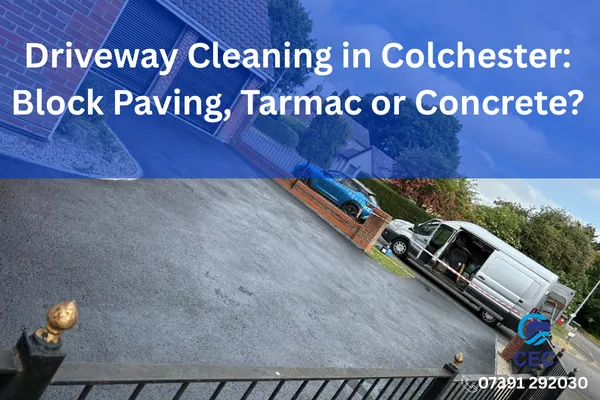
Driveway Cleaning in Colchester: Block Paving, Tarmac or Concrete?
A driveway can put up with years of abuse before you really notice how much its appearance has changed.
Cars drive across it every day.
Leaves sit on it through autumn.
Tyres bring in dirt from the road.
Moss appears around the edges.
Weeds start popping through joints.
A little oil leaks from a car and somehow manages to land exactly where everyone can see it.
Then one day you look at an old photograph of the house and think, was the driveway really that colour?
Professional driveway cleaning can make a huge visual difference, but there’s something homeowners need to know before anybody starts pressure washing.
Block paving, tarmac and concrete aren't the same surface.
They age differently. They collect dirt differently. They also need different care during and after cleaning.
Colchester Exterior Cleaning works with a range of driveway surfaces across Colchester and Tendring, including block paving, tarmac and concrete. The cleaning process is adjusted according to the surface and its condition.
Here’s how the three most common driveway types differ.
First, Work Out What Your Driveway Is Made From
This sounds obvious, yet homeowners sometimes inherit a driveway when they buy a property and have no idea exactly what it is.
Block paving is usually easy to recognise. It’s constructed from individual blocks laid in a repeating pattern, with narrow sand-filled joints between them.
Tarmac creates a continuous dark surface. Older tarmac commonly fades from deep black towards grey as it ages.
Concrete can appear as one continuous slab or several larger sections separated by joints. It may be smooth, textured, coloured or patterned.
Knowing what you have matters because the safest cleaning method changes with the surface.
Block Paving: One of the Most Satisfying Driveways to Clean
Block paving can produce some spectacular before-and-after results.
The transformation happens because dirt builds up gradually.
The blocks lose their original colour. Green growth appears. Weeds move into the joints. Traffic marks develop where cars regularly enter and leave.
Because the deterioration happens slowly, you get used to it.
Once part of the driveway is cleaned, the difference can be striking.
Why Does Block Paving Become So Dirty?
Block paving contains lots of joints and textured surfaces where material can collect.
Dust and soil settle into the paving.
Damp conditions encourage algae and moss.
Seeds find their way into joints.
Leaves sit on the surface and gradually break down.
Vehicle traffic adds another layer of grime.
Properties surrounded by trees may notice this happening faster, especially in parts of the driveway that remain shaded.
A north-facing front garden can behave very differently from a driveway receiving direct sunlight for much of the day.
Can You Pressure Wash Block Paving?
Yes, when it’s done correctly.
Marshalls recommends using medium pressure and holding the lance at an angle when cleaning block paving. It warns that excessive pressure can mark some paving and disturb the jointing material.
That last point matters.
Those gaps between the blocks aren't decorative.
They contain jointing sand that forms part of the paving system.
Pavingexpert explains that the sand between blocks helps create the interlock that allows the driveway to carry vehicle loads.
So a driveway clean doesn't finish the moment the dirt disappears.
Why Does Block Paving Need Re-Sanding?
Pressure washing inevitably removes some material from the joints.
If enough sand disappears, it should be replaced once the paving has dried.
This is called re-sanding.
Kiln-dried sand is swept across the surface and worked back into the joints.
Pavingexpert advises that the surface should be dry when this is done so the fine sand can move freely into the gaps.
Marshalls also states that sand removed during pressure washing should be replaced before substantial traffic returns to a block-paved driveway.
Skipping this stage can leave a driveway looking clean while an important part of its construction has been removed.
If you're paying someone to pressure wash block paving, ask whether re-sanding is included or whether it's required for your particular driveway.
Are Weeds Growing Up From Under the Blocks?
Sometimes, although there’s a common misconception here.
You may look at weeds growing between the blocks and imagine huge plants forcing their way up from underneath the driveway.
Seeds can also settle in the material that collects within the joints.
Soil, dust and organic matter gradually create an environment where weeds can establish themselves.
Removing the visible growth and cleaning the joints can dramatically improve the appearance.
Future seeds can always arrive again because the driveway remains outdoors.
Regular sweeping helps reduce the material available for them to grow in.
Will Pressure Washing Stop Block Paving Weeds Forever?
No.
Cleaning removes existing dirt and growth.
It can't prevent every future seed from landing on the driveway.
Re-sanding the joints after cleaning is still important.
Some homeowners also choose to have block paving sealed after cleaning and re-sanding.
Whether sealing is suitable depends on the paving, its condition and the product being used.
It should never be treated as a compulsory part of every driveway clean.
Should Block Paving Be Sealed?
Sealing is an additional option.
A suitable sealer can change the finished appearance and may help protect certain paving from staining and future contamination.
Preparation is crucial.
Pavingexpert recommends allowing cleaned block paving to dry thoroughly before applying sealant because residual moisture can cause problems with the finished coating.
That means a driveway shouldn't be pressure washed at lunchtime and automatically sealed a couple of hours later simply because the surface looks dry.
Water can remain within the blocks and joints after the top appears dry.
Weather conditions matter too.
If you're interested in sealing, discuss it separately from cleaning and establish whether it’s appropriate for your driveway.
Can Oil Stains Be Removed From Block Paving?
Often they can be improved, although results depend on the age and severity of the stain.
Oil can penetrate porous concrete blocks.
A pressure washer may remove surface dirt while leaving the darker oil mark behind.
Pavingexpert documented exactly this during a block-paving refurbishment. Pressure washing removed the dirty surface contamination, yet a specialist treatment was required to tackle oil that had penetrated into the paving.
This is why stain removal and ordinary driveway cleaning aren't always the same job.
If you have a large oil stain, point it out when asking for a quote.
It may need specific treatment.
What Else Should Be Checked on Block Paving?
Cleaning can reveal problems that dirt was hiding.
You may discover a sunken patch.
Some blocks may move.
Edges can deteriorate.
There may be broken blocks.
Older repairs can become much easier to see once everything is clean.
Cleaning won't correct settlement or structural problems.
If a section has sunk because the underlying construction has failed, it needs repair.
A clean sunken block is still a sunken block.
Tarmac Driveways Need a Different Approach
Tarmac behaves very differently from block paving.
There are no sand-filled joints across the main surface.
The material also changes as it ages.
Fresh tarmac has that familiar dark appearance.
Over time it can become greyer, faded and tired-looking.
Traffic, sunlight, weather and contamination all affect the surface.
Colchester Exterior Cleaning offers tarmac restoration alongside driveway cleaning because some older tarmac needs more than surface dirt removed. The existing service covers cleaning, appropriate repairs and restoration treatment where suitable.
Why Does Tarmac Turn Grey?
Ageing tarmac gradually loses the rich dark colour people associate with a newly laid driveway.
That can leave homeowners wondering whether it’s dirty.
Sometimes it is dirty.
Sometimes the surface itself has faded.
Often, you're seeing a combination of both.
This is a crucial distinction because pressure washing can remove grime.
It can't turn an aged grey surface into fresh black tarmac simply by washing it harder.
If the driveway is clean but still looks washed-out, restoration may be the next option to consider.
Can You Pressure Wash a Tarmac Driveway?
Tarmac needs controlled cleaning.
A strong jet concentrated too aggressively on an older or weakened area can disturb the surface.
Condition matters enormously.
A relatively sound driveway covered in ordinary surface contamination presents a different job from old tarmac with loose aggregate, cracks and crumbling edges.
Before cleaning starts, look for weak areas.
Can you see cracks?
Are the edges breaking away?
Are small stones becoming loose?
Has part of the driveway started sinking?
Those clues tell you something about the condition beneath the dirt.
Cleaning and Restoring Tarmac Are Different Jobs
This distinction can save a lot of confusion.
Imagine an old tarmac driveway that has faded to grey.
It also has green organic growth around the edges.
Cleaning can remove the green growth and accumulated grime.
The original ageing remains.
Restoration can then address the faded appearance where the existing tarmac is suitable for treatment.
Colchester Exterior Cleaning's tarmac restoration process starts with cleaning and can include repairs to small cracks or holes before an appropriate restoration coating is applied.
So if your driveway looks old after it has been cleaned, that doesn't automatically mean the cleaning failed.
You may simply be looking at the true condition of the tarmac.
Can Old Tarmac Be Restored Instead of Replaced?
Sometimes, yes.
This depends on the condition of the driveway.
A tired surface with fading and manageable defects may be a candidate for restoration.
A badly failed driveway with serious structural problems is a different situation.
Cleaning or applying a restoration treatment won't rebuild a failed base underneath the surface.
If your driveway has extensive sinking, severe cracking or large areas breaking apart, replacement or substantial repair may need to be considered.
The useful first step is to establish what condition the tarmac is actually in.
What About Oil on Tarmac?
Vehicle oil is one of the most common driveway stains.
Fresh spills should be dealt with quickly where practical.
Older oil contamination can be harder to remove.
Tarmac itself contains bituminous material, so the choice of cleaning product matters.
Using random household chemicals can create a bigger problem.
When requesting professional driveway cleaning, mention oil or fuel staining separately.
A photograph is particularly useful.
The cleaner can see where the stain is, roughly how large it is and what surrounding surface needs protection.
Concrete Driveways Are Tough, but They Still Need Care
Concrete has a reputation for being virtually indestructible.
It is certainly a hard-wearing driveway material.
It can still be marked or damaged through aggressive cleaning.
Concrete also varies.
You may have fairly plain concrete, decorative concrete, coloured concrete or a textured finish.
Age and condition make a difference too.
Marshalls recommends starting pressure washing cautiously, using no more force than necessary and testing a small, inconspicuous area before cleaning paving more extensively.
That’s sensible advice for any driveway where you're uncertain how the surface will respond.
Why Does Concrete Become Dark?
Concrete is porous.
Over time it can collect environmental contamination and staining.
You might see tyre marks where cars regularly stop.
Green algae can develop in damp areas.
Dark organic contamination builds around edges.
Rust marks may appear beneath metal objects.
Oil can create obvious patches.
The original pale concrete gradually becomes much darker.
Professional cleaning can remove significant amounts of accumulated contamination and expose the cleaner surface underneath.
The change is often particularly obvious where part of the concrete was protected by a pot, bin or other object.
Move it and you suddenly have a patch showing what the driveway looked like years earlier.
Can Pressure Washing Damage Concrete?
Yes, particularly when excessive pressure is concentrated too close to the surface.
A pressure washer creates a very powerful jet of water.
Holding it inches away from one spot for too long can mark the surface.
You may also create visible lines if the cleaning pattern is inconsistent.
Marshalls advises using medium pressure on paving, maintaining a suitable distance and carrying out a trial first to reduce the risk of surface damage.
Professional rotary surface-cleaning equipment can help produce a more consistent result across larger areas.
Technique matters as much as machine power.
What Are Those Dark Lines Across My Concrete?
Not every mark is dirt.
Cracks, previous repairs, expansion joints and natural colour variation may remain visible after cleaning.
This is something homeowners sometimes only discover when the surface is clean.
Before cleaning, the whole driveway can look uniformly grey.
Afterwards, old repairs suddenly stand out.
Cleaning reveals the driveway.
It doesn't change the underlying construction.
That’s why realistic expectations matter.
Can Rust Stains Be Removed From Concrete?
Rust can often be treated, although the correct product matters.
You might see rust beneath metal garden furniture, plant stands, gates or items left on the driveway.
Rust behaves differently from algae or ordinary road grime.
Pressure alone may have limited effect.
Specialist stain treatments may be required.
Always identify what caused the mark first if possible.
If a rusty object is still sitting in the same place, cleaning the stain without addressing the source means you'll probably be doing the job again.
Which Driveway Type Is Easiest to Clean?
There isn't one simple winner.
Block paving responds very well to cleaning, though the joints and re-sanding need attention.
Concrete can often be cleaned effectively, with pressure controlled to protect the surface.
Tarmac can be cleaned, but age and condition require particular care. A faded tarmac drive may also need restoration if improving its colour is part of the goal.
The cleaner needs to know what they're working with.
That’s far more useful than arriving with one pressure setting for every driveway in Colchester.
Is More Pressure Better?
No.
This is probably the most useful thing to understand about pressure washing.
Professional equipment can produce considerable force.
The skill comes from using enough cleaning power for the job without unnecessarily attacking the surface.
Marshalls specifically warns that excessive force can damage paving and its joints.
Pavingexpert also cautions that repeated high-powered washing can loosen block-paving joints and damage some paving surfaces.
If dirt isn't moving, there may be another reason.
Perhaps it’s a stain that needs treatment.
Maybe you're looking at black lichen.
The surface itself may have faded.
Increasing pressure doesn't solve every exterior-cleaning problem.
What About a Domestic Pressure Washer?
Domestic pressure washers can be useful for routine outdoor cleaning.
Take care with technique.
Start conservatively.
Keep the lance moving.
Avoid concentrating the jet on one small area.
Pay particular attention to block-paving joints.
Remember that any jointing sand removed needs replacing.
Marshalls recommends testing an inconspicuous section first and keeping the nozzle a suitable distance from the paving.
If you have a large driveway, heavy organic growth or specialist staining, professional equipment can make the job considerably more manageable.
You also avoid spending most of Saturday soaked from the knees down while discovering that your driveway is much larger than you thought.
Why Do Pressure-Washed Driveways Sometimes Look Striped?
This usually comes down to inconsistent cleaning.
Holding a lance at different distances creates different levels of cleaning.
Moving too slowly through one section can clean it more aggressively.
The result can be obvious lines or patches.
Rotary surface cleaners are designed to clean broader areas more evenly.
Colchester Exterior Cleaning uses professional rotary surface-cleaning equipment as part of its driveway-cleaning service.
Edges and awkward sections may still require separate attention.
Should You Clean a Driveway Before Selling Your House?
If it’s visibly dirty, it’s certainly worth considering.
The driveway can occupy a huge part of the front of a property.
Estate-agent photographs often capture most of it.
A heavily green, weed-filled driveway can make the whole frontage appear tired even when the house itself is well maintained.
Cleaning is especially worthwhile where the original paving has become hidden beneath years of contamination.
We've covered the wider preparation process in our guide to what you should clean outside before selling your Colchester home.
The same principle applies.
Look at the property from the road.
If the driveway dominates what you see, its condition matters.
When Is the Best Time to Have a Driveway Cleaned?
Spring is popular because people start paying attention to their gardens and exterior spaces again.
Summer can work well too.
There’s also value in dealing with slippery growth before wetter autumn and winter conditions.
The ideal timing depends on what needs doing after the clean.
If block paving requires re-sanding, dry conditions help.
If you're considering sealing or tarmac restoration, weather becomes even more important because the surface needs suitable drying and application conditions.
You can still ask for a quote at any time of year.
The work itself can then be planned around the surface and forecast.
Why Does One Side of My Driveway Turn Green?
Shade is usually worth investigating.
One side may receive plenty of sunlight.
The other sits beside a wall, hedge or neighbouring property.
That shaded area takes longer to dry after rain.
Moss and algae then have better conditions to grow.
Marshalls notes that paved areas beneath trees or in persistent shade can require more frequent cleaning and that wet leaves left on paving may cause staining.
Regularly sweeping leaves and organic debris from these areas can help.
You may never stop every trace of green growth because the underlying conditions remain.
Maintenance can stop it building up as heavily.
What About Drainage During Driveway Cleaning?
Drainage deserves attention.
A heavily contaminated driveway can produce a surprising amount of dirty water and debris during cleaning.
Pavingexpert recommends checking gullies and drainage channels after pressure washing so they aren't left clogged with the material removed from the paving.
This is one of the less glamorous parts of professional driveway cleaning.
Cleaning the paving and leaving a drain full of sludge isn't a finished job.
Can Driveway Cleaning Remove Every Stain?
No responsible cleaner should promise that without seeing the stain.
Ordinary dirt, algae and many types of surface contamination can respond extremely well.
Deep oil can be more difficult.
Rust needs specific treatment.
Some marks may be physical changes to the surface.
Old damage and repairs remain after cleaning.
If you have a stain that's particularly bothering you, take a close photograph and include it when requesting a quote.
That gives us a chance to identify what treatment may be appropriate.
How Often Should You Have a Driveway Professionally Cleaned?
There isn't a fixed schedule.
Some driveways stay presentable for years.
Others develop green growth quickly because they're shaded by trees or buildings.
The best guide is the actual condition.
If it still looks good, leave it alone.
If moss and algae are spreading, weeds have taken over the joints or the original colour has disappeared under years of contamination, cleaning may be worthwhile.
Regular sweeping between professional cleans can make a real difference.
Remove leaves before they break down.
Deal with spills quickly.
Keep drainage channels clear.
A little maintenance helps prevent a bigger cleaning job later.
Driveway Cleaning Around Colchester
Driveways vary enormously across Colchester.
You’ll see large block-paved frontages around modern estates, older tarmac drives, concrete parking areas and properties where several materials have been added at different times.
A driveway in Stanway may have a completely different surface and layout from one in Lexden.
Homes around Highwoods, Wivenhoe, West Bergholt and the surrounding villages bring another mix.
The postcode doesn't decide how a driveway should be cleaned.
The surface does.
We look at what the driveway is made from, how old it appears, what contamination is present and whether there are existing defects.
Then the cleaning method can be chosen accordingly.
Block Paving, Tarmac or Concrete: What Happens After Cleaning?
For block paving, check the joints. Re-sanding may be required once everything is properly dry.
For tarmac, look at the underlying colour and condition. If the surface remains faded after cleaning, restoration could be worth discussing.
For concrete, allow the cleaned surface to dry and reassess any remaining stains, cracks or old repairs.
The important part is recognising that cleaning exposes the real driveway.
Sometimes that's all it needs.
Sometimes it shows you what the next maintenance job should be.
Frequently Asked Questions About Driveway Cleaning
Can block paving be pressure washed?
Yes. The pressure and technique need to be controlled, and jointing sand removed during cleaning should be replaced. Marshalls recommends medium pressure and angled cleaning to reduce the risk of damaging the paving and joints.
Why does block paving need re-sanding?
Jointing sand contributes to the interlock between individual paving blocks. Pressure washing can remove some of this sand, so the joints may need topping up once the driveway has dried.
Can a tarmac driveway be pressure washed?
Tarmac can be professionally cleaned, although the surface condition needs to be checked first. Older, loose or deteriorating areas require particular care.
Why has my tarmac driveway turned grey?
Tarmac naturally changes appearance as it ages and weathers. Cleaning removes surface contamination, while an appropriate tarmac restoration treatment may be considered where improving the faded finish is the goal.
Can faded tarmac be restored?
Some faded tarmac driveways can be restored if the underlying surface remains suitable. Colchester Exterior Cleaning offers a separate tarmac restoration service that can include cleaning, minor repairs and restoration treatment.
Can concrete driveways be pressure washed?
Yes, when the condition and finish of the concrete are suitable. Excessive pressure can mark a surface, so controlled cleaning and an initial test area are sensible.
Can driveway cleaning remove oil stains?
Some oil staining can be significantly improved, although pressure washing alone may not remove oil that has penetrated a porous surface. Specialist stain treatment can sometimes be required.
Will pressure washing remove weeds from block paving?
It can remove visible growth and material within the joints. Future seeds can still settle in the driveway, so weeds may return over time.
How long should block paving dry before re-sanding?
The paving needs to be sufficiently dry for kiln-dried jointing sand to move freely into the joints. Weather conditions affect how quickly this happens.
Should I seal my driveway after cleaning?
Sealing is optional and isn't suitable for every situation. The paving needs to be clean, properly dry and compatible with the chosen sealer. Discuss sealing separately after the driveway has been assessed.
Why does my driveway become green every winter?
Shade, moisture and organic debris can create favourable conditions for algae and moss. Sections near trees, walls or hedges may stay damp for longer.
Does Colchester Exterior Cleaning clean different driveway surfaces?
Yes. The driveway-cleaning service covers surfaces including block paving, tarmac and concrete, with the cleaning method adjusted according to the material and its condition.
Need Your Driveway Cleaned in Colchester? Get a No-Obligation Quote
If your driveway has become green, stained, weedy or so dirty that you've forgotten what colour it used to be, Colchester Exterior Cleaning can take a look.
Whether you have block paving, tarmac or concrete, we'll assess the surface first and explain the most suitable cleaning approach.
For block paving, we can also discuss re-sanding where required. If you have an older faded tarmac driveway, we can advise whether cleaning is enough or whether our tarmac restoration service may be more suitable.
You can upload photographs directly through our contact form, which makes it easier for us to see the driveway and any particular stains or problem areas before discussing the work.
Visit our Contact Us page today and request your no-obligation driveway cleaning quote.

